Tuesday, June 29, 2010 0 comments

June Link Dump

Complicated Currents: Media Flows, soft Power and East Asia (edited by Daniel Black, Stephen Epstein and Alison Tokita) is online for free. Good reading.

- Michael's Breen walks us through the 13-month-long Second Republic. A great writeup.

- How does one exactly talk about a non-traditional family in Korean? Asadal Thought candidly shares his experiences.

- What gives? I'm still waiting for a part four of ROK Drop's fascinating look at Korea's ghost airports. To be fair though, a fourth installment was never actually promised....but still... Read Parts I, II, III on your own or to get an idea of what's going on, BBC has a short video about the curiously abandoned airports.

- Laura and Lisa Ling's book is out.

- In more important news, AAK has an excellent primer for what's going on with this whole sinking of the ROKS Cheonan.

- Matt over at Gusts has some good stuff about Korea during the Japanese protectorate period.

- China unearths more Terracotta Army soldiers. Any luck of getting inside Qin Shi Huang's tomb anytime soon?

- Hye Cho's travel journal is going on display.

- China admits North Korea started the Korean War. Am I wrong in thinking that 이승만 was preparing to invade?

- The Colosseum is opening up the gladiator's waiting pit for the first time for the public. Good to know seeing as how the outside is falling apart.

- A well preserved shoe older than Stonehenge was found buried in sheep poo in Armenia. Great archeological find with a great photo.

- Amelia Earhart might have survived for months on a desert island.
Monday, June 28, 2010 1 comments

Words I don't know and other writing woes

Writing is an entire language of its own. There's beauty to be found in a few written phrases over the cacophony of spoken word. However, I'm not a phenomenal writer despite a short, illustrious and unpaid career as a blog writer. Oh the trailblazers who write for free. However, I dream of a world outside the electronic realm of publishing. I long for a collection of words bounded and printed on the deceased flesh of a dozen bleached and pressed infant trees. I want to cherish my name which has been carefully crafted upon the binding which contains stories of the past all contained in the comfort of thinly sliced bark that I ordered to be slaughtered. Yes, a relic of my upbringing, I dream of writing a book. Realistically, to receive the recognition required for a ragamuffin of my rank, I must resolve to remedy and remove reins that restrain my resounding rapport for writing about the past. That last verb counts too, right?

See? There's the problem. I get going and then I unexpectedly run into a wall. Call it a lack of functioning vocabulary but sometimes I'm searching for a word that just might not be in my head. I try not to let it get me down but it's frustrating to find myself recycling the same words. Thankfully, I seem to have some obtainable options.

There's lots of good tips out there but what I hear most from writers that I personally respect is two major tips 1) just write and 2) keep good footnotes. DailyWritingTips also has a great  many resources written in layman's terms that any writer person would benefit from. Tips include basics that I should remember but don't like how  to properly write numbers and what does [sic] mean to middle-of-the-road problems like redundancies  and even a great Latin  prefix and suffix primer for those that care.

To be a better reader, I take notes and write all over my books when I read. I underline with a pencil, write references and questions in the side margin and occasionally write a few cuss words in the header. From time to time, I come across words or events that I don't recognize. In which case, I flip to the front page before the title and make a note if the page and title of the event. Therefore, most of my books have really ugly inside cover pages. I also write down any new words in English that I am unfamiliar with or, more commonly, that I've heard, I kind of understand but would be hard pressed to produce on my own in my own work. I am a little hesitant to admit the following words but I suppose we all have room for improvement; that's just what I'm telling myself when I feel your judgmental stare at the screen. The following list is from the insides of as many books I can find laying around:

abrogate
promulgate
efficacious
impetus
apocryphal
scion
repudiate
ostensibly
gendarmerie
panacea
persona non grata
billet
polemics
mea culpa
pugnacity
clandestine
settee
gauche
bailiwick
neophyte
replete
approbation
ad valorem
hegemony
succinct
missive
consternation
and my personal favorite out of the bunch: verisimilitude

First step: find an opportunity to use gauche in a sentence.
Next step: look up "gauche" in the dictionary.
Friday, June 4, 2010 0 comments

Book Review: The Foreign Destruction of Korean Independence

Title: The Foreign Destruction of Korean Independence
Author: Carole Cameron Shaw
Hardcover: 315 pages
Publisher: Seoul National University Press (April 25, 2007)
ISBN-10: 8952107705
ISBN-13: 978-8952107701


One can't help but raise an eyebrow simply over the title of this project published from decades-long respected member of Korea's foreign community Carole Cameron Shaw. A few pages into the first chapter reveals a particularly developed voice that possesses an alarming amount of indignation directed at American indifference in the events leading up to the Japanese colonization of Korea. The title alone will catch your attention but is it enough to keep you interested till the end?

A truly intricate dance of characters, the lengthy cast includes President Theodore Roosevelt, Korean Emperor Kojong, Secretary of State Elihu Root, Scholar-Diplomat William Woodville Rockhill, Japanese Prime Minister Ito Hirobumi, American Ambassador Edwin Morgan and missionary-turned-journalist Homer Hulbert among others including John Hay, Horace Newton Allen, George Kennan and Durham W. Stevens. Each played his part in the events that led up to the Treaty of Portsmouth, subsequent Eulsa Treaty and eventual colonization of Korea by the hand of Japan five years later. Each had a side to belong to; essentially one pro-Japanese and the other pro-Korean. While some stuck to their guns, others wavered in their opinions; still others failed to come out of the whole ordeal alive. The events these individuals played out beg the reader to question one of many things. For example, didn't Korea have twenty-plus years of internationally recognized independence prior to Japanese occupation? Why did Japan display such keen interest in Korea's development?

Chinese and especially Russian checking of power comes to mind. A possible takeover of Korea from supposed land-hungry Russia could threaten Japanese expansionism. Although we will never exactly know what may have unfolded had no one intervened, Shaw dutifully points out that Korea might have dealt with any upset in the balance of power in her own terms. Present-day historians continue to debate the significance of Kojong's self-imposed set of sweeping modernizations known as the Gwangmu Reform and whether they would have been enough to modernize the country without Japanese intervention. Shaw touches on this subject but spends an extensive amount of time demonstrating America's major players' indifference to Korean issues in the name of illegally improving relations with Japan. Consistent themes include America's lack of diplomatic action, Roosevelt and company's apathy for all things Korean and deliberate violations of the U.S. Constitution.

The almost cynical narration continues throughout the book and occasionally emerges seemingly louder than before where logic and fact would fit far better. Those with varying levels of interest in Korean history may perhaps question the book's validity simply based on the writing style and the far-too numerous questionable wordings such as "...it would soon dawn on him (Kojong) that Miss Roosevelt's visit was a trick among many, to disguise America's true intentions towards her old friend (p.143)" and "Of course Roosevelt knew this, and his refusal to meet with Hulbert can only be characterized as cowardly (p.172)". Statements like these hurt Shaw's argument not because they are factual inaccurate but because they beg for objective balance. The whole text just feels way too one-sided for anyone's benefit.

The book does contain plenty of redeeming material such as a fantastic English bibliography of personal correspondence by not just ambassadors and statesmen but also to and from President Roosevelt and a detailed account of events from 1882-1908 including the second Hague Peace Conference. Curiously though, the famous assassinations of Stevens and Hirobumi are only but briefly covered. There's also a decidedly lack of non-English language sources. However, if nothing else, the book's against-the-grain approach takes on a different perspective that might have gone unnoticed. Indeed, historical apologists seeped in Japanese doctrine have written unflattering tales of King Kojong and the corrupted yangban for their faults in driving Korea into lax submission to the Eastern emerging superpower known as the Empire of Japan. This book tells a very different story of a Emperor trying everything in his power to save his kingdom but is ultimately betrayed from neighbor to the East for her lies and deception but moreso from her ally across the ocean for just sitting and watching as the Korean voice is forever silenced.

Shaw's rather outspoken opinion can conveniently be summed up in one sentence lifted from the last chapter: "I would assert that under these clearly defined principles the burden of guilt rests upon President Roosevelt and Secretary of State Elihu Root, for entering into a fraudulent arrangement with the Japanese Government to look the other way while ill-conceived, illegal and hastily constructed statements were prepared under the guise of a legal protocol or treaty, to effect a military and violent takeover of a sovereign state to whom the Senate had pledged its good faith and perpetual friendship in 1882 (p.278)".

In summation, The Foreign Destruction of Korean Independence is worth your time as it reads quickly and entices enough to make you want to delve deeper; a good quality for a book to have, especially considering the subject. Despite its scoff-inducing knack for emotional flair, the book is backed by more than decent research. Ultimately, the book likens itself to American filmmaker Michael Moore; while thought-provoking and occasionally entertaining, it is clearly armed to the teeth with a specific agenda. Thankfully, a few objective pieces of information can be sifted through the finger-pointing and sensationalist rhetoric. I applaud Shaw for her research, writing and development of the book in hopes of paving the way for more in the future. I suppose if Shaw's intention was to get people to talking about the subject, then I say mission well accomplished.

- - -

I'm treading lightly here and I know it. Shaw spent a considerably huge amount of her life in Korea; it's hard to simply trash any author's work based on my own difference in interpretation; especially an author that spent ten years delving into a piece of Korean and American history that is little more than brushed under the proverbial rug of our collective subconscious. That being said, I maintain that her book is far from objective. It's borderline anti-American sensationalistic gossip wrapped in Korean nationalistic propaganda. For another review's opinion, members of the Association of Asian Studies can access one of the back issues of JAS that features a review by Eugene Y. Park. Search for "The Journal of Asian Studies (2008), 67:331-333 Cambridge University Press".
Wednesday, May 26, 2010 0 comments

RASKB lecture - Superstitions and Perceptions of Early Korean-Western Relations

It was good to see that I wasn't the only one looking forward to the lecture. A highly anticipated night, as per the RASKB website:
May 25, 2010 RAS Lecture Meeting
Tuesday / 화요일 Mr. Robert Neff
7:30 p.m. 2nd floor, Residents’ Lounge
Somerset Palace, Seoul
Superstitions and Perceptions of Early Korean-Western Relations
Following the opening of Korea to the West in 1882, Westerners entered Korea for various reasons. Some came as diplomats, representing and protecting their countries’ interests, while others came as advisors to the Korean government. There were merchants seeking business opportunities and many missionaries who provided altruistic services such as education and medicine all in the name of their religion. Some came to Korea seeking a new beginning; hoping to hide their unsavory past. To all of these groups, Korea was a newly-found frontier and an undiscovered market for what they had to offer.
In this lecture we will talk about the interaction between these early Westerners and their Korean hosts by examining Korean superstitions and the perceptions and misperceptions of the Westerners and Koreans.
The introduction of various Western technologies such as the railroad, streetcars and electricity were all, in the beginning, viewed with suspicion and fear by some of the more superstitious Korean people. Often these first encounters with these new technologies provided us with humorous anecdotes but occasionally ended in violence. The Westerners tended to either look upon these Korean superstitions as quaint or with disdain but were not above using them for their own gain as will be shown in the lecture.
Perception, or perhaps misperception, was also a factor in early Korean-Western relations. Sometimes misperceptions led to awkward and embarrassing encounters such as young Korean boys mistaken for bold girls or a young American male missionary mistaken for a young pretty lady. Other times these misperceptions led to violence as during the Baby Riots which will be discussed in detail during the lecture.
Robert Neff is a freelance writer and historical researcher specializing in Korean history during the late 19th and early 20th centuries. He first came to Korea with the military over two decades ago and has a deep appreciation for Korean culture and its history. He is the co-author of Korea Through Western Eyes as well as Westerner’s Life in Korea and his writings have appeared in various newspapers, magazines and books including Christian Science Monitor, Asia Times, Morning Calm, Korea Witness, Royal Asiatic Society – Transactions, Korea Times, Korea Herald and Jeju Weekly.
Despite an unfortunate technical difficulty that resulted in Neff's powerpoint not being available to view, the topic was juicy and plenty interesting. Essentially an off-shoot of his most recent book Neff touched on some rather sensitive sentiments from a hundred years ago.

Of dutiful mention was foreign men's constant confusion over handsome young men and the gentler sex. Time after time, rugged travelers happened upon delicate flowers of the Orient who were indeed not graceful members of the opposite sex but in fact fabulously well groomed young men with excellent bone structures. We all had a laugh; especially at the perception on the opposite side of the spectrum. Neff tells of a half balding, mustachioed George Heber Jones, his trek across the Taedong River and subsequent encounter with a uncomfortably beckoning 아저씨 that had either had to much to drink too early in the day or was seriously misinformed of the standards of foreign women. It seems Jones was quite possibly mistaken for a young foreign female...for some reason.

To sum up the rest of the lecture, there was a lot of talk of exposed breasts, baby eating and naked children. In the author's defense, however, these were simple observations made a hundred years ago. The rather unflattering comments were from a time past and are clearly not meant in a pejorative way in modern times. As one commenter brought up, many of these misconceptions were not exclusive to Korea and no insinuation should be made of disrespect.

The lecture was full of other interesting and head scratching observations of times past. Early on in the questioning, Neff referred to himself as simply a "gossip columnist from a hundred years ago", which I will now affectionately affix to his work from now on. In addition to meeting Jennifer of Bomb English fame and Matt from Gusts of Popular Feeling, rubbing elbows with some of Korea's most well respected journalists, writers and historians is not a bad way to spend a Tuesday night in Seoul. If you missed it, shame on you.

Some other quick notes (kind reader feel free to leave corrections):
  • The first Westerners to set foot in Korea were likely some Portuguese that accompanied the Japanese during the Imjin War.
  • The Imo Revolt of 1882 was placated by the end of an especially long dry-spell throughout the country. It was believed that the death of the Japanese solved the drought.
  • Prior to 1910s, there were only three well-documented international relationships consisting of Western men and Korean women. They include Percival Lowell, Dr. Charles Power, and an unnamed (rather, disputed) French diplomat whose lover tragically came back to Korea only to commit suicide years later. Was there not a mention of a snake oil peddler? Dr. Irwin? Can't remember...
  • For a lower class woman to expose her breasts in the countryside was a sign of pride; a badge of honor for bearing a son.
  • It is suspected that the Taewangon masterminded the Baby Riots. You know, the one where foreigners were supposedly eating slash using human baby limbs, sexual organs and eyes for making photographs and whatnot.
  • Despite the average height of the Korean male being 5' 4½" back in the day, Koreans were frequently compared to Chinese and Japanese as being the most tall and good looking.
  • According to common mention in old journals, letters, articles and such, references to Korean's cleanliness standards, namely their lack of any discernible standards, was notorious. One quote that stuck with me which I will now butcher with a cloudy short-term memory, was "...if filthiness is a virtue, then Koreans are by far the most virtuous people in all of the world."
  • Apparently there was a seven foot tall Korean female servant in the royal court named 고태수 (spelling?) who, apparently after growing tired of teasing remarks of her height, participated in the 1884 Kapshin Coup.
  • It is speculated that prior to Japanese occupation, and sebsequent education reform, Koreans were especially talented at learning English quickly. Prince 이진호 (spelling?) was said to have been sent to Japan to study English in 1881 and was trilingual as a result.
Friday, May 14, 2010 0 comments

Book Review: Korea Witness

Title: Korea Witness
Editors: Don Kirk, Sang-Hun Choe
Softcover: 472 pages
Publisher: EunHaeng NaMu; 1st edition (June 2, 2006)
ISBN-10: 8956601550
ISBN-13: 978-8956601557


The archetypal image I have for foreign correspondents isn't exactly flattering nor is it accurate. For that matter, it's not even of flesh and blood. It's a stock news reporting character from The Simpsons. No, not everyone's beloved Kent Brockman or even that guy with the poofy black hair who reported that pork prices began to rise in early trading. No, I'm referring to the skinny guy who dishevely dons a drab 1940s style suit and brown fedora. You might remember that he was with Bart when Blinky, the three-eyed fish, was discovered in the polluted waters downstream of the nuclear power plant. Although he has only appeared in the long-running TV series less a handful of times, you might have an image of him. Then again, you might not. His name, while completely forgettable, was actually Dave Shutton and he writes for the Springfield Shopper. I make this reference because like real foreign correspondents in Korea, their names may not be familiar to you at all but their presence and stories surely have captivated you. Korea Witness is a collection of dozens of stories of how these pioneers of their field got their scoops as well as the trails and tribulations associated with reporting the news in Korea.

Chronologically arranged, this book spans the careers of several generations of journalists and their careers involving Korea and its foreign press. Stories from parachute journalists based in Tokyo and English speaking Koreans working for foreign presses share their fascinating and surprisingly shocking stories from their time. From meeting other hacks, dodging Korean war bullets and bombs, interviewing CEOs in Japanese, rubbing elbows with Korean presidents, dangerously sneaking into the Gwangju student-led powder keg, pre-email era dictating horrors, enduring death threats and surviving tear gas assaults, these men (and one Pulitzer prize winning woman) have earned their right to call themselves journalists. Their stories are just as dynamic as any Hollywood movie.

The book design is non-distractingly pleasing and thoughtfully laid out. The plentiful amount of photos embedded are often breathtaking in their own right and certainly compliment the attached article. Cleanly laid out at the end of each entry is a short summary of the author which is footnoted to help fill in certain biographical details that might help the reader better understand the author's relationship with Korea. The editors have accepted works from a wide range of writers and the book is all the better for it.

However, one early chapter about Japanese correspondents in particular feels like a rough draft of what could have been a memorable story. There's not else much to criticize other than the comparatively small amount of non-Caucasian American male voices to be heard but that's likely indicative of both the language of the book and the likely small ratio of European, Chinese and Japanese correspondents of the time.

Korea Witness is an smooth and entertaining read. If not limited in scope, it tells of a war-torn, post-Liberation, economic miracle, Olympic hosting, economic collapsing, technology exporting powerhouse that, through the eyes of the foreign press, have plenty of stories to tell. This book sums up those stories quite nicely.

- - -

Respectfully disagreeing with Ask A Korean's ambivalence towards English language resources on Korea, these trailblazers did their job admirably and in my opinion contributed immensely to the world's understanding of Korea. Not only did it raise my awareness of the Seoul Foreign Correspondents Club (SFCC), but it really put some human perspective on certain events. The first hand accounts of surviving a Korean war bomb, investigating No Gun Ri, and the tragic death of 육영수 are worth the price of the book alone. Plus its got the Neff. You can't really go wrong with this one.
Wednesday, May 12, 2010 2 comments

May Link Dump

This won't always be a feature so don't fret if link dumps aren't your thing.  Relax and click away:

Ask A Korean has a word or two about the recent announcement of Korean and Japanese scholars issuing a joint statement on history. His English translation is well worth reading. (read more)

Respected, if not occasionally controversial, journalist Michael Breen getting sued by Samsung for an apparent libel Christmas joke. (read more)

Thoughts on ActiveX the Joseon Dynasty (read more)

Korean economy is good in Q2 (read more)

I'm pretty sure I'd fail this test (read more)

Some young Korean woman like foreign men. In other news, water is wet. (read more)
Monday, May 10, 2010 1 comments

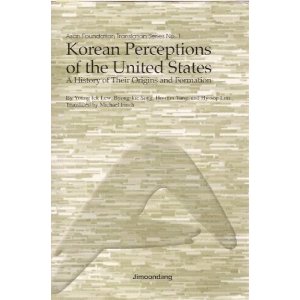
Book Review: Korean Perceptions of the United States

Title: Korean Perceptions of the United States: A History of Their Origins and Formation
Author: Young Ick Lew, Byong-kie Song, Ho-min Yang, Hy-sop Lim, Michael Finch
Hardcover: 394 pages
Publisher: Jimoondang (February 10, 2006)
ISBN-13: 8988095901


It seems the longer the title, the less commercial value a book has. It becomes perfectly clear when a book has nothing but a simple clipart graphic for a cover and a curious lack of illustrations inside that this will be a book only for those with a specific interest. No matter the time and effort spent on such a valuable contribution to the field if the book looks like a total bore. However, don't be turned off by the lack of flair and narrow scope of interest because there's a lot to be had in such a text. Such is the case with Korean Perceptions on the United States: A history of their origins and formation.

Well respected historian Young Ick Lew collaborates with three (not counting the translator) other well rounded and equally respected professors to present a 140 year-long timeline of the views and opinions of America broken into four identifiable periods of time spanning from before 1882 to post-Liberation. The first chapter, serving as a sort of overview, is sufficient enough for the casual reader to understand the five major stereotypes of America and why Koreans have believed as such. However, for a more detailed account, the remaining four chapters serve as excellent sources of reference.

There's a lot of good stuff in here, believe me, but it's not the most page-turning book I've picked up. The fourth chapter especially seems to drag on and feels monotonous. There's also a fair amount of high context references that might go over a casual readers' head. But then again, how many casual readers of Korean-American international perceptions can there be? The book unsurprisingly covers the post-Liberation period only briefly and avoids delving into modern relations perhaps out of respect for the droves of modern analyses widely available.

I came away from this book feeling a bit drilled and rehashed but also well informed and enlightened. I take confidence to refer to history in order to better understand the present situation between the two countries and this book delves into the nitty gritty of such history. There's also a wonderful bibliography, concise index and even a list of Hanja-based names for America found on pages 40-41. While it's not going to be on everyone's shelf due to its lack of flair and limited distribution, because of its comprehensive English language contribution and excellent reference value, I say it should.

- - -

Although at times it felt like pushing a mule through the mud just to get through another page, I'm glad I read it. It was a bit disappointing coming off the heels of the last book I read from Professor Lew but it still did what I'm sure it set out to do: make a valuable contribution.
 
;