Wednesday, May 12, 2010 2 comments

May Link Dump

This won't always be a feature so don't fret if link dumps aren't your thing.  Relax and click away:

Ask A Korean has a word or two about the recent announcement of Korean and Japanese scholars issuing a joint statement on history. His English translation is well worth reading. (read more)

Respected, if not occasionally controversial, journalist Michael Breen getting sued by Samsung for an apparent libel Christmas joke. (read more)

Thoughts on ActiveX the Joseon Dynasty (read more)

Korean economy is good in Q2 (read more)

I'm pretty sure I'd fail this test (read more)

Some young Korean woman like foreign men. In other news, water is wet. (read more)
Monday, May 10, 2010 1 comments

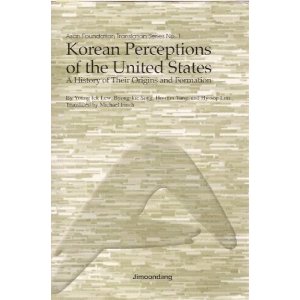
Book Review: Korean Perceptions of the United States

Title: Korean Perceptions of the United States: A History of Their Origins and Formation
Author: Young Ick Lew, Byong-kie Song, Ho-min Yang, Hy-sop Lim, Michael Finch
Hardcover: 394 pages
Publisher: Jimoondang (February 10, 2006)
ISBN-13: 8988095901


It seems the longer the title, the less commercial value a book has. It becomes perfectly clear when a book has nothing but a simple clipart graphic for a cover and a curious lack of illustrations inside that this will be a book only for those with a specific interest. No matter the time and effort spent on such a valuable contribution to the field if the book looks like a total bore. However, don't be turned off by the lack of flair and narrow scope of interest because there's a lot to be had in such a text. Such is the case with Korean Perceptions on the United States: A history of their origins and formation.

Well respected historian Young Ick Lew collaborates with three (not counting the translator) other well rounded and equally respected professors to present a 140 year-long timeline of the views and opinions of America broken into four identifiable periods of time spanning from before 1882 to post-Liberation. The first chapter, serving as a sort of overview, is sufficient enough for the casual reader to understand the five major stereotypes of America and why Koreans have believed as such. However, for a more detailed account, the remaining four chapters serve as excellent sources of reference.

There's a lot of good stuff in here, believe me, but it's not the most page-turning book I've picked up. The fourth chapter especially seems to drag on and feels monotonous. There's also a fair amount of high context references that might go over a casual readers' head. But then again, how many casual readers of Korean-American international perceptions can there be? The book unsurprisingly covers the post-Liberation period only briefly and avoids delving into modern relations perhaps out of respect for the droves of modern analyses widely available.

I came away from this book feeling a bit drilled and rehashed but also well informed and enlightened. I take confidence to refer to history in order to better understand the present situation between the two countries and this book delves into the nitty gritty of such history. There's also a wonderful bibliography, concise index and even a list of Hanja-based names for America found on pages 40-41. While it's not going to be on everyone's shelf due to its lack of flair and limited distribution, because of its comprehensive English language contribution and excellent reference value, I say it should.

- - -

Although at times it felt like pushing a mule through the mud just to get through another page, I'm glad I read it. It was a bit disappointing coming off the heels of the last book I read from Professor Lew but it still did what I'm sure it set out to do: make a valuable contribution.
Wednesday, April 28, 2010 0 comments

Old Seeds

Noah's Ark may have been found, but that's nothing. Goryeo Dynasty lotus seeds successfully sprouted. That's an old seed, buddy.
A Lotus has been grown from a 700-year-old seed which dates back to Korea's Goryeo Dynasty.
The plant has been grown in Haman County, South Gyeongsang Province, South Korea.
The flower has been grown from one of the 10 lotus seeds discovered during an excavation of an ancient castle last year.
Scientists at the Korea Institute of Geoscience and Mineral Resources, have confirmed two of the seeds to be as old as 650 years and 760 years, respectively
The county also planted the eight other seeds and three of them sprouted. (HNN)
Saturday, April 24, 2010 0 comments

Maps of War: Korea

Okay so not exactly.

I enjoy Maps of War's few but very easy-on-the-eyes flash presentations. Of notable mention is the History of Religion and the Imperial History of the Middle East. However, I always thought to myself it would be a pipe dream to have a Korean map on the site. Judging by the lack of recent updates and the "©2006" at the bottom of the site, it looked like the site is down for the count. Well, I didn't find the exact same thing but pretty close. It's not perfect; it has some empty portions that plead for you to fast forward only to find yourself overwhelmed by twenty events happening all within a year or two. It's not the smoothest ride but for being eight years old, it's not a bad presentation. This animated map spanning from 200CE to 1000CE is awesome and deserves some credit. Sit back and enjoy.

TimeMap is an open-source software that functions very similar to the maps seen at Maps of War. The particular TimeMap being mentioned was created under a joint project by the University of Sydney and the National Institute of Korean History. I would love to get my hands on more if they exist. Also of note are other animated maps on the Chinese Dynasties, the Mongolian Empire and the like. Make sure to browse the sample gallery for more. To learn more about TimeMap, check out their pdf brochure on how to get the most out of the software.


0 comments

Korean Studies Survey Consultant

Something I'm not at all qualified for but still quite interesting to read about was this position to look into the affairs of Korean Studies in North America. Since I'm early in the game, this seems like a great idea and definitely worth while for the field; a real contribution. For the old timers this surely sounds like a dream. I can't imagine what it was like to study Korean history or language 30 or 40 years ago with no internet, limited contact by snail mail and just by the luck of finding other qualified people in the field by chance or by word of mouth. Oh and I believe telephones were out back then, too. It must be nice to see Korean studies get the attention it deserves. Anyways, taken from the archives:
The Social Science Research Council is searching for a consultant to
coordinate a Survey on Korean Studies in North America. The consultant
will be responsible for the development, implementation, and
coordination of an in-depth survey of the Korean Studies field in the
United States and Canada. The consultant will report to the Fellowships
Manager.
The survey, to be undertaken over a two-year period, will offer a
comprehensive evaluation of the field of Korean Studies in North
America. Changes in government policy and foundation funding priorities
in the mid-1990s that de-emphasized area studies have undoubtedly had an
impact on the development of the Korean Studies field. The survey will
focus on Korean Studies at the university and college level and assess
the spread of Korean studies across disciplinary fields, faculty and
student demographics, available Korean Studies curriculum, student
interest, support and funding opportunities, and linkages with Korean
institutions through study abroad and less formal connections. In
addition to quantitative data, in-depth follow-up interviews with
faculty, students, and other relevant actors such as funders, deans, and
center directors to obtain qualitative information will be essential to
a nuanced understanding of the field. This qualitative piece will probe
issues the survey can only hint at, such as questions of why and how,
process, and intent, as well as decision making processes. The results
of the survey and interviews will be compiled in a final report and
point to a way forward for continued support of the field. The survey,
interviews, and reports will provide a clear understanding of Korean
Studies in North America.
The major objectives of the survey are to reassess the field of Korean
Studies and:
* to provide a more complete understanding of the state of Korean
Studies in North America by
documenting recent developments and current trends in the field,
identifying scholars (faculty and students) at work in the field,
and evaluating existing Korea-related programs at U.S. and Canadian
institutions of higher education.
* to offer a comparison of the state of the Korean Studies field to the
state of the Japan Studies field,
* to review the availability of funding and resources to scholars in the
field,
* to identify the strengths, weaknesses, needs, and opportunities for
growth within the field, and
* to offer important guidance on revising priorities for funding and
support toward activities and projects that will provide the most
impact.
In cooperation with SSRC and Korea Foundation staff as well as experts
in the field of Korean Studies, the consultant will take the lead on
survey design, testing, survey implementation and the coordination of
result analysis and report preparation. In addition, the consultant will
be responsible for conducting follow-up interviews and site visits to
various institutions with strong curricular offerings in Korean studies.

2010/2011 Schedule:
Late Spring/Early Summer 2010: Preliminary research, survey site
selection, and survey development
Summer/Early Fall 2010: Conduct Survey
Fall 2010: Preliminary results and data analysis; preliminary report due
in October 2010
Fall 2010l/Winter 2011: In-depth survey analysis, follow-up research,
site visits, and development of second year proposal based on identified
needs. This consultancy will take place starting immediately and will last
through March 14, 2011 with the possibility of a one-year renewal.
Payment will be commensurate with experience.
If you were wondering who is qualified to take on such a task, here's your answer.
Qualifications
* PhD in a quantitative social science field
* Experience in survey design, implementation, and analysis
* Familiarity with online survey tools, such as Survey Monkey, and
qualitative data analysis software, such as NVivo.
* Excellent organizational skills with strong attention to detail,
project management experience a plus.
* Excellent writing and oral communication skills.
* Must be able to work independently and as part of a team.
* Korean language ability strongly recommended.

Please send a resume and cover letter with one writing sample via email
to: applications@ssrc.org (Please put "Survey Consultant" in the title
of the email.)
The Social Science Research Council (SSRC), founded in 1923, is an
independent, non-profit organization devoted to supporting innovative
social research and solving pressing global challenges.
Tuesday, April 20, 2010 2 comments

Preservation of battlefields

Ran across something about a Wal-Mart and a battlefield today:
Preservation issues -- such as the one going on with Wal-Mart and the Wilderness battlefield -- are going to become only more contentious in coming years as suburban sprawl and economic development collide with once-rural Civil War battlefields.
It often comes down to a matter of money vs. history.
It got me thinking about how battlefields might just be beginning to be encroached in America but with Korea having less than 3% of the total land mass of America, this problem has surely been addressed time after time in Korea's population dense nation, right? What is the future of the Korean War's Iron Triangle or the Punch Bowl? The field where the Battle of Gapyong seems to be doing fine but when will that change? Hell, the whole DMZ for that matter... These are just within the last sixty years, though. I can't imagine old Koguryo-era battlefields and what they look like today. Curiously, I can't seem to find any land battle markers that predate the Korean War. Obviously hundreds exist but my internet search skills seem to be failing me at the moment. Any help from the peanut gallery? Any Japanese invasion fields I should know about? 삼국시대 battlefields?

I suppose the obvious answer has always been to bulldoze and build over any significant piece of land regardless of its past save for a few that have gone incidentally untouched. It is nice to find a particularly old timey gate being restored in its original location.
Saturday, April 17, 2010 3 comments

RASKB lecture - Contradiction of Seoul's Urban Architecture

Last week I attended another lecture hosted by the good folks of the Royal Asiatic Society - Korea Branch. From the website:
April 13, 2010 RAS Lecture Meeting
Tuesday / 화요일 Prof. Kim, Sung Hong
7:30 p.m. 2nd floor, Residents’ Lounge
Somerset Palace, Seoul
Contradiction of Seoul's Urban Architecture
Why doesn’t Seoul, a city with a history of over 600 years, look more traditional? Why is the cityscape dominated by high-rise buildings, apartments and signs? If Seoul is one of the places people most want to visit, why is it considered by many one of the worst cities? From where do these contradictions derive?
To understand Seoul’s contemporary architecture, we must review Seoul’s development by looking back to the 14th century and its evolution up to the present.
In this lecture we will look at how early industrialization, urbanization, and the industrial structure of today have shaped Seoul’s contemporary architecture. We will also look at the different issues facing Korean architects as well as their European and American counterparts, what steps they are taking and the choices they have been and still can make. We will also take a look at the exhibition “Megacity Network: Contemporary Korean Architecture,” which was held in Seoul and four cities in Europe over the past two years.
Sung Hong KIM is a professor of architecture and urbanism at the University of Seoul. He studied architecture at Georgia Tech in Atlanta, the University of California at Berkeley, and Hanyang University in Seoul. He has served as an organizer of the Korea-Germany Public Space Forum at the Frankfurt Book Fair in 2005, was a Fulbright Visiting Scholar at the University of Washington in 2006, an organizer of the “Megacity Network: Contemporary Korean Architecture” exhibition in Frankfurt, Berlin, Tallin, Barcelona and Seoul 2007-2010, and was the provost of the Planning and Research Office of the University of Seoul 2007-2008. He has published several publications about Korean architecture and urbanism in Korean and English.
What actually transpired was a very short but pleasantly entertaining survey of the 600 year history of Seoul as told by a seemingly very nice and well-spoken Korean professor. Unsurprisingly, at the end of the lecture, there were many questions (I believe one was even from professor Stephen Epstein who happened to be in attendance) about the sheer ugliness of Seoul's urban landscape. I can't fault the speaker for avoiding the question because frankly, ascetics are not his field; modern architecture is and he certainly isn't responsible for the concrete ugliness of the post-Korean war construction boom.

However, I was able to jot down a few notes that I'd like to post. The only question I personally asked but didn't get a full response was about 한옥. I asked if there was an internal movement to preserve 한옥 or a group or company that is pushing to build new 한옥 in the old style. Professor Kim did mention that it has only been within the last ten years or so that a few NGOs have actually tried to preserve Hanok at all outside of 복촌, a section of Seoul that has a somewhat larger number of 한옥 located in the northern part of Seoul.

Anyways, here's what I learned:
- The "일산 New Town" concrete apartment complex was a five year start-to-finish project.
- Seoul was a planned city dating back to the 14th century
- The designers followed closely, but not exactly, not the Chinese principle of urban development. I didn't catch the name of it though..anyone know it? 주리?
- Unlike European cities, Seoul highlighted the government markets (시장) in the center of the city and hid the residential district behind it.
- Seoul has intentional asymmetrically designed palaces in accordance with Korean geomancy (풍수지리)
- 명동성당 was controversial for many reasons, one being that it was higher than the King's palace
- During the Japanese colonization period (일제 강점기) the city's landscape was changed rapidly
- Jongno's (종로) storefront's name is 피말기 or something like that. Something that means "even a horse would avoid it". Not sure exactly about that. Readers? * 피맛골 as per the comments. Thanks Matt!
- 1/5 people in Korea live in Seoul
 
;